Standardization of Old Hungarian scripts' spelling,
𐲢𐳛𐳮𐳁𐳤 𐳏𐳉𐳗𐳉𐳤𐳑𐳢𐳁𐳤 𐳉𐳎𐳤𐳋𐳍𐳉𐳤𐳑𐳦𐳋𐳤𐳉
Unicode submissions – drafts documents and accepted document
Unicode submissions
Start of standardization in 1998
The first proposal for a Székely-Hungarian rovas script was submitted by Michael Everson, based on the
alphabets of Gábor Hosszú and Zoltán Für(?). There are several ligatures that have been used throughout
the standardization process, but there are also ligatures that are foreign to the Hungarian language,
such as: "oskánt", "názti". There was no mention of foreign signs.
First submission in 2008, submission by authors Everson and Szelp
The Everson and Szelp did not yet distinguish between upper and lower case letters, and some
long vowels were missing from the draft. The agreed
ligatures were included, except for the "modern ligatures."
These shortcomings were later corrected.
Gábor Hosszú deviated from the agreement on a few points: he defined foreign
ligatures as letters and also included the 500 sign.
He treated letter forms loosely. For the letters Ü and Ű, he did not indicate the origin
(Nikolsburgi or Rudimenta), but supplemented them with the word old.
He submitted his draft under the name "Székely-Hungarian rovas".
From then on, no one else was entitled to use the name.
Since the submission itself was not accepted in the end,
the name could no longer be used.
The order of the letters is not yet final. In Everson's first 2008 proposal
and in the one below, the first recommendation is for number representation. One hundred thousand should not be written with a hundred thousand
sign!
The solution: a hundred sign followed by a thousand sign. As if we were reading (Right to left): 𐳾𐳿
Carpathian Basin rovas script: There is no evidence that either the Székelys
or the Hungarians used it.
Purpose: unknown. What does it have to do with us?
Khazar rovas writing: The writing of an extinct people, of which we don't even know
what origin they were. (Turkish or other) There is no evidence
that either the Székelys or the Hungarians used it. Purpose: unknown.
What do we have to do with it?
Everything fell apart here: the Khazar rovas: the writing of an extinct people, about whom we don't even know
what kind of people they actually were.
Carpathian Basin writing, a script about which it cannot be proven conclusively
who exactly used it. And the draft standard for the Székely-Hungarian rovas.
All of this has been incorporated into a single standard!
This was followed by a meeting of the board of trustees,
where the participants heard representatives of both submissions,
and after discussion, voted overwhelmingly in favor of the Everson-Szelp submission.
The draft submission by Everson and Szelp was accepted.
The final Unicode Standard of Old Hungarian script.
I am Viktor Kovács, an IT engineer. In my work, I focus on the IT and historical authenticity of Rovas writing
and related technologies
(Unicode standardization, font development, input devices).
I carry out my activities independently of all domestic and foreign civil organizations,
foundations and movements.
My goal is to integrate Rovas writing into the modern digital environment,
strictly in accordance with historical sources and
international IT standards (Unicode). I consider functional
language use to be particularly important,
which includes the requirement of phonetic transcription of foreign names
for the readability of Rovas inscriptions.
I ask the professional community and content producers to respect this independent,
technology-focused approach when making any reference to my research results or my name.
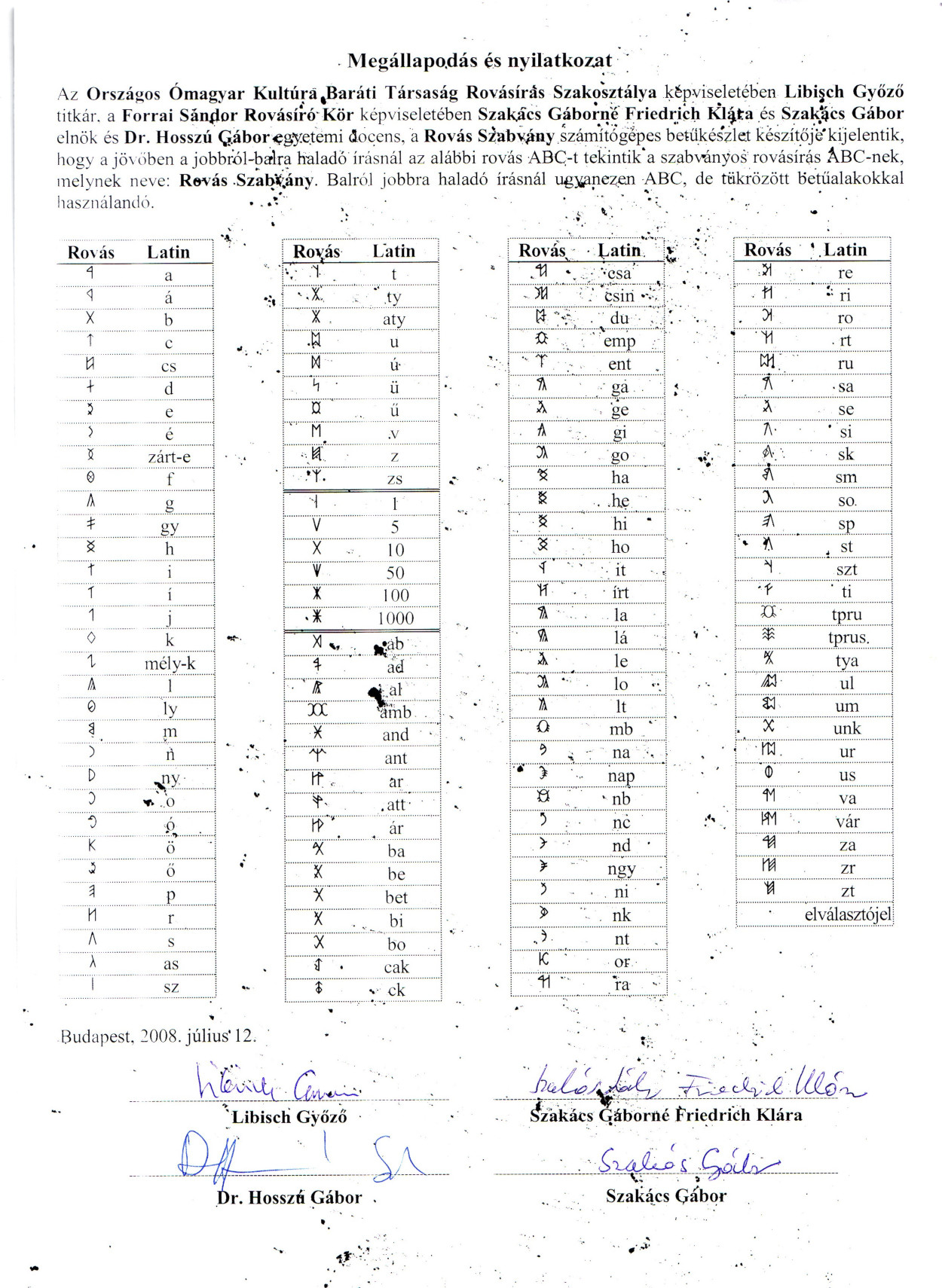 Copy of the letter of intent at BME