Theoretical foundations
Our Latin-based writing system is governed by the Hungarian Academy of Sciences' "Rules of Hungarian Spelling",
12th edition, which is the most recent version. The Academy Publishing House is authorized to distribute it.
(ISBN 978 963 05 9631 2)
Point 10 of the lettering section defines the alphabet. Our Rovas writing uses a phonetic alphabet
and so-called historical symbols. For example: "ny", IPA: "ɲ",
"𐳚"!
In some finds, ligatures were also used, which means the merging of written letter combinations.
In our Latin-based alphabet, the letter "y" is used as a softening sign in Hungarian words.
Latin-based writing differs from Rovas writing in that there are no "dz" IPA: "d͡z" and "dzs" IPA:"d͡ʒ"
letters among the historical (not created) Rovas signs. The ligature form designed for the 'dz'
sound is an overly complicated shape. There are old Hungarian-Latin texts where the 'ds' letter
combination was used instead of the modernized 'dzs' form; thus, the chosen ligature form can be
considered arbitrary."dz", IPA: "d͡z" "𐳇𐳯"
These two sounds were not used because they were foreign to the language.
In the Hungarian spelling rules, section 11 of the chapter on letters defines the letters q, w, x, and y as
letters that often occur in writing practice.
Here is a pdf file
about Hungarian and Old Hungarian letters, IPA codes, and examples.
Practical guidelines
Noble names and the rovas script:
It is important to note that some Transylvanian noble families
changed the letter "V" to "W" after Transylvania was annexed
to the Austrian Empire.
An example of this is the name of Baroness Kata Vesselényi,
which appears in a Transylvanian church.
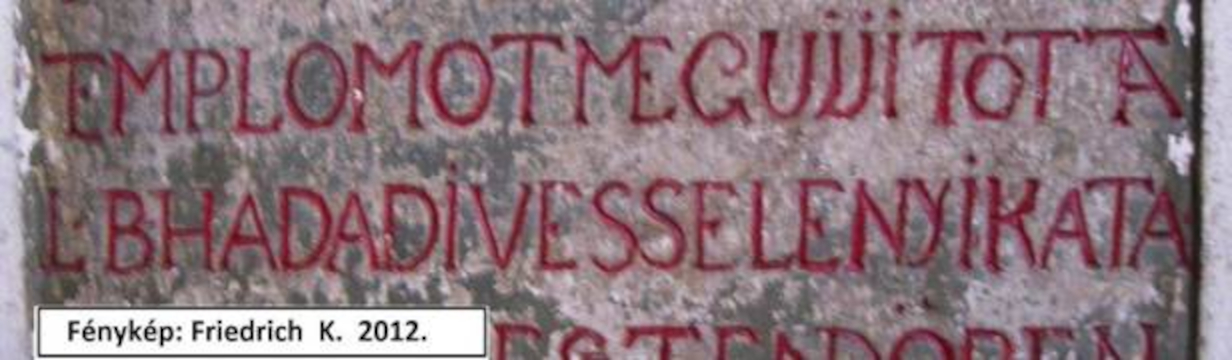
Memorial tablet on the wall of a Transylvanian church.
The inscription: the church was renovated by Baroness
Kata Vesselényi of Hadid.
The reason for Germanization is that Germans pronounce the letter "v" as "f".
The letter "y" used at the end of noble names to represent the sound "i" is not
used as a clear rule.
Consider, for example, the name of Count István Széchenyi.
In the
1800s, some peasant families' names were also recorded with the letter "y" in the registry.
Batthyány's name is a real curiosity. Syllabically: "Bat-thyá-ny", the letter combination "thy"
is "ty" IPA: "c" in Old Hungarian script: 𐳨,
while the word-final "ny" is pronounced "nyi" IPA: ɲɪ (
𐳚𐳐)! Rovas writing is phonetic, which is particularly
critical in this situation. Noble name Batthyány written in IPA: ˈbɒcːaːɲi, and in Rovas:
𐲂𐳀𐳨𐳨𐳁𐳚𐳐
Arguments against the use of "modern" letters.
An argument against the use of "Y" is that its pronunciation is unclear:
Ybl : IPA: ˈiːbəl, Rovas phonetic: 𐲑𐳂𐳖
York: IPA : jɔːk: Rovas phonetic: 𐲒𐳛𐳢𐳓
When translating English names and place names, we can end up with meaningless gibberish if
we translate them letter by letter. for ex.: Shakespeare. IPA: ˈʃeɪkspɪə , written according
to Hungarian pronunciation: ʃeːkspɪr.
With Rovas, Latin letter by letter equivalents: 𐲤𐳏𐳀𐳓𐳉𐳤𐳠𐳉𐳀𐳢𐳉
. By phonetic Rovas:
𐲤𐳋𐳓𐳥𐳠𐳐𐳢
The latter solution is easier to understand while reading, and the traditional phonetic method of Rovas
writing prevails.
The first solution is more difficult to read. First, you have to work out what it would look like
in Latin transcription, then understand that the name is not of Hungarian origin, and then interpret
who it refers to.
Argument against the letter "Q":
The specified ligature recommendation does not give the true meaning of the letter "Q", the
ligature "Kv",
which is not "Q" but "Qu"! The letter combination "Qu" is also used, for example,
in Russian spelling as "kv", i.e. "кв". Quebec: Квебек, recommended in Rovas:
𐲓𐳮𐳉𐳂𐳉𐳓
Argument against the letter "W":
Historical Rovas writing did not differentiate between the letters V and W.
When translating English names and place names, we can end up with meaningless gibberish if we
translate them letter by letter. E.g.: New York. IPA and in Rovas:
Loanwords and Rovas:
Recently, the Hungarian Academy of Sciences (MTA, Magyar Tudományos Akadémia) has endeavored to shape our orthography by adapting long-established loanwords into a more Hungarian form:
software: szoftver, hardware: hardver, nylon: nejlon, both spray and spré are accepted, both quad and kvad are accepted. It is therefore recommended to follow this trend in Rovas writing as well!
Archaic and Swabian Names
Variations for representing the "cs" sound in surnames: Takáts, Áts, Madách, Széchenyi.
In my opinion, these letter combinations can be safely adopted.
The archaic "Cz" spelling for our "C" IPA: "t͡s"
sound can also be adopted: Czuczor.
The "th" at the end of surnames representing the "t" sound: Horváth, Tóth, Németh. It can be adopted.
The orthography of Swabian names differs from Hungarian. Reading them based on Latin conventions is quite difficult.
"Schäfer", IPA: "ʃeːfɛr"
𐲤𐳋𐳌𐳉𐳢
Important: The pronunciation of Swabian names used in Hungary differs from standard German pronunciation!
Correct Use of the Letter aK (𐳔)
In certain historical sources, besides the meaning of the letter registered in the standard as "aK," the term "vég" (end) or its Latin equivalent also appears. It is recommended to include this rule among the fundamental principles of orthography.